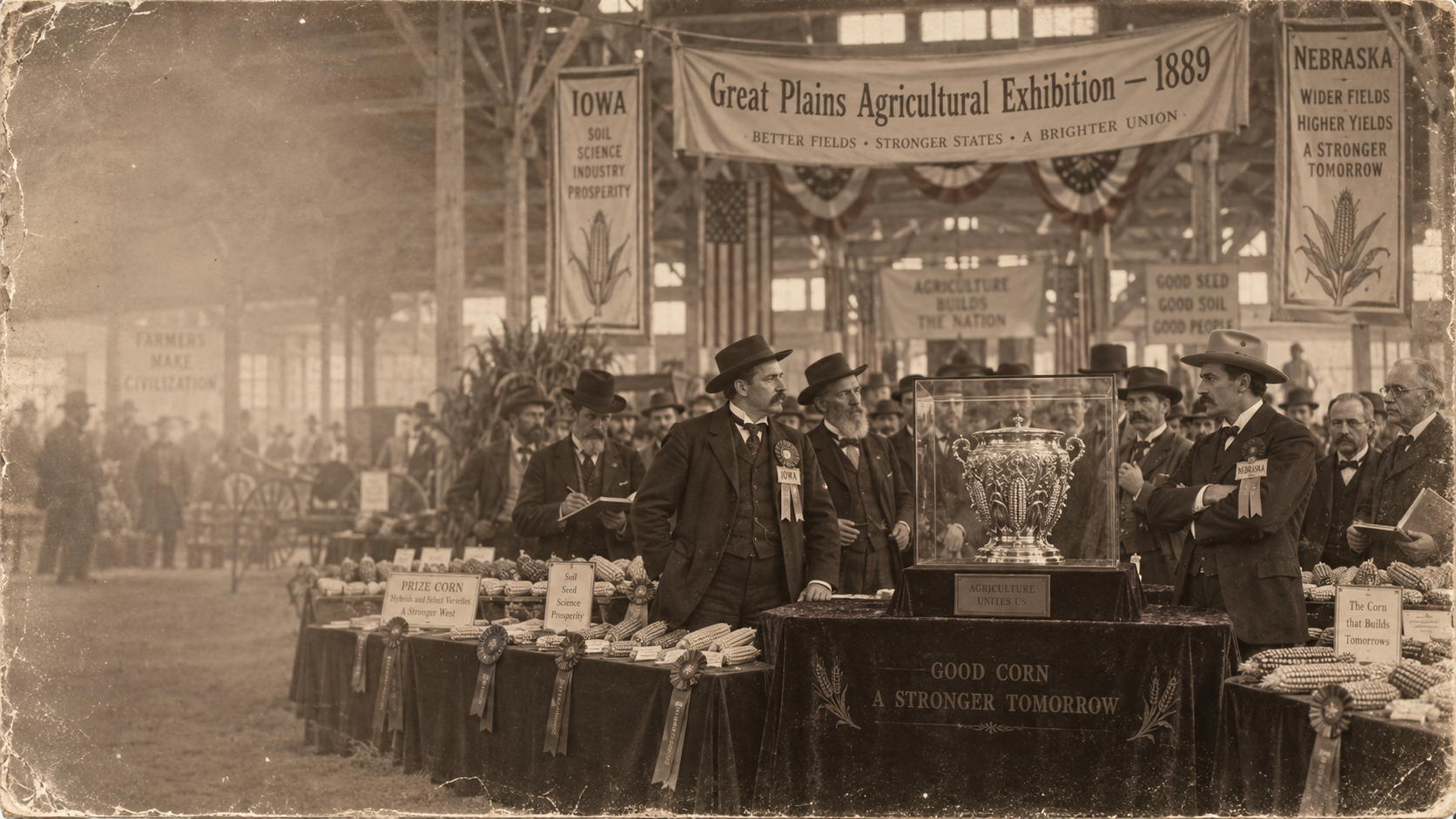
The Great Plains Agricultural Exhibition, 1889. Society Archives
BEFORE THERE WAS A RIVALRY
In the closing decades of the nineteenth century, Iowa and Nebraska were rapidly becoming two of the nation’s most important agricultural states. Their land-grant colleges were expanding the study of crop science, plant breeding, soil management, and agricultural education.
Corn was not merely a crop. It was increasingly a matter of science, economics, civic pride, and regional identity.
What began as professional disagreement between agricultural scholars would eventually escape the laboratory, divide neighboring states, and create a controversy that neither side has successfully settled.
The Cornfrontation began with scholars, not athletes.
THE SCHOLARS 1884–1894
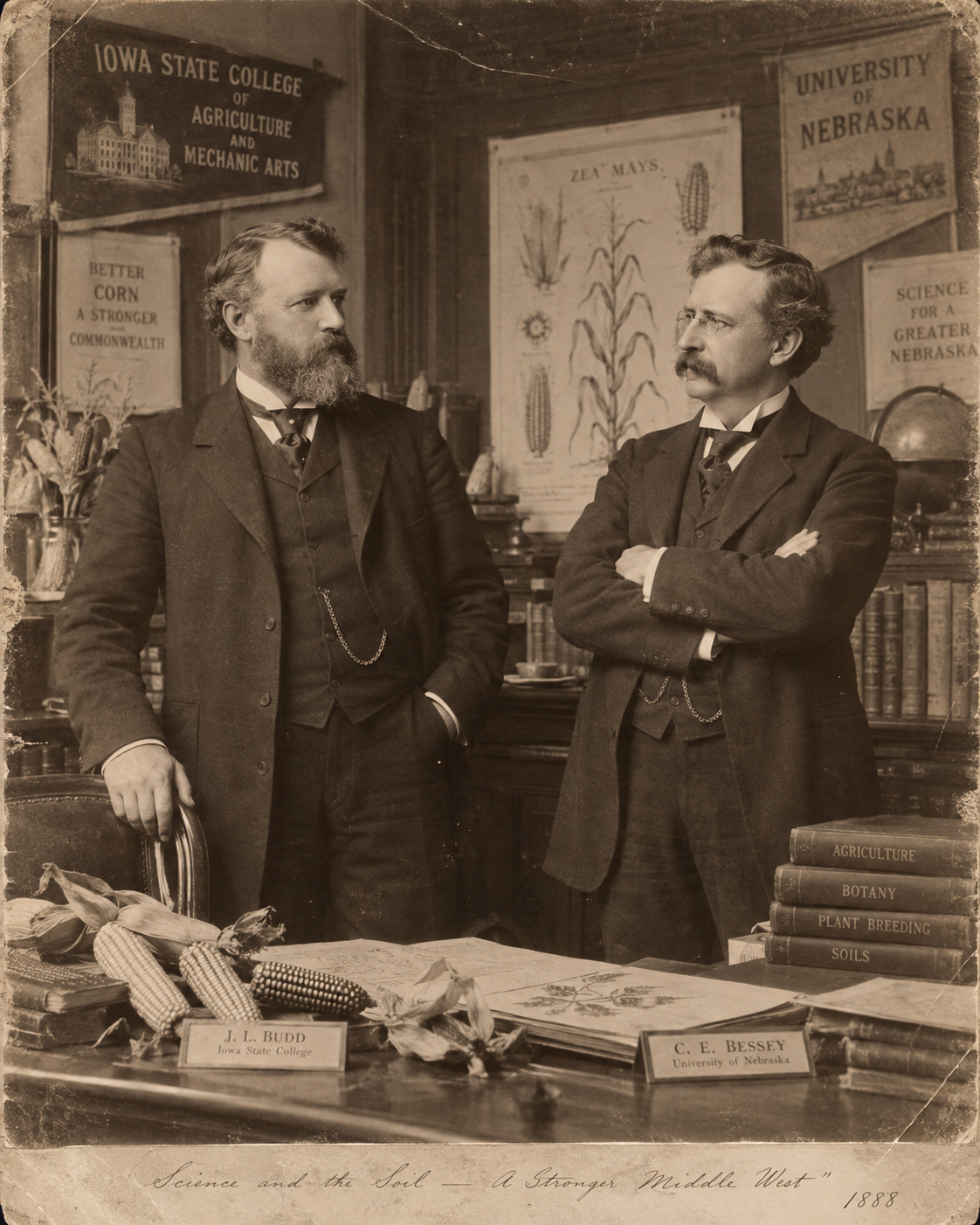
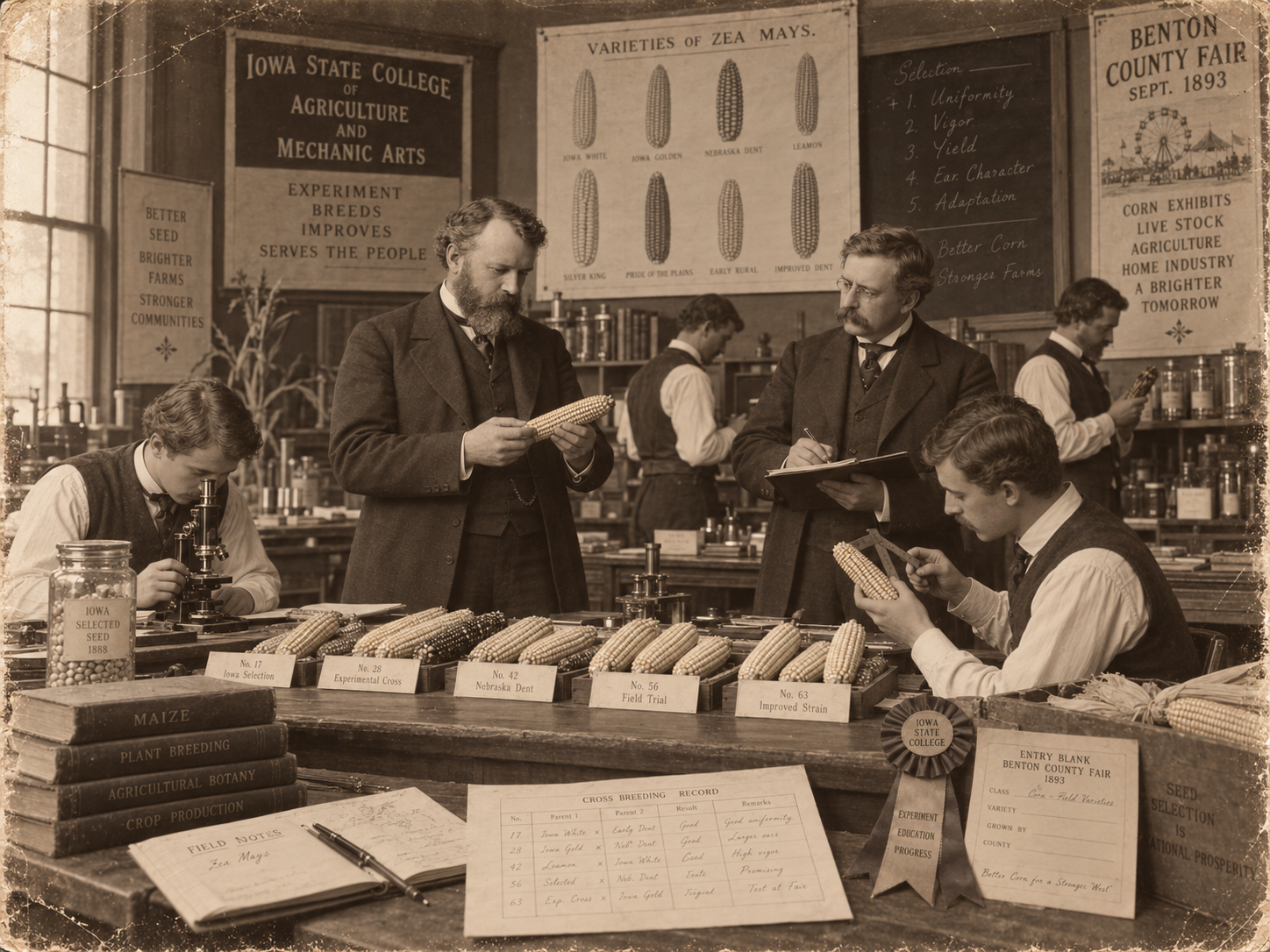
Two figures stand at the beginning of the Cornfrontation tradition: Joseph Lancaster Budd of Iowa State College of Agriculture and Mechanic Arts and Charles Edwin Bessey of Nebraska.
Both men were respected agricultural scholars. Both believed that scientific agriculture could transform the Great Plains. And both developed increasingly strong opinions about how the region's farmers should select, cultivate, and improve corn.
Their disagreements were initially professional. They did not remain that way.
As agricultural colleges competed for influence, students, research funding, and recognition, differences in philosophy began to acquire a distinctly regional character. Iowa increasingly argued that disciplined selection and refinement produced the superior ear. Nebraska countered that vigor, adaptability, and the conditions of the western plains demanded a broader standard.
Soon the question was no longer simply: What makes good corn?
It became: Who grows it better?
THE GREAT PLAINS AGRICULTURAL STANDARD
1889 — A trophy becomes a problem.
By the late 1880s, agricultural exhibitions had become important showcases for the rapidly developing science of Midwestern farming. Universities, agricultural societies, and growers competed not simply for ribbons, but for recognition that their methods represented the future of American agriculture.
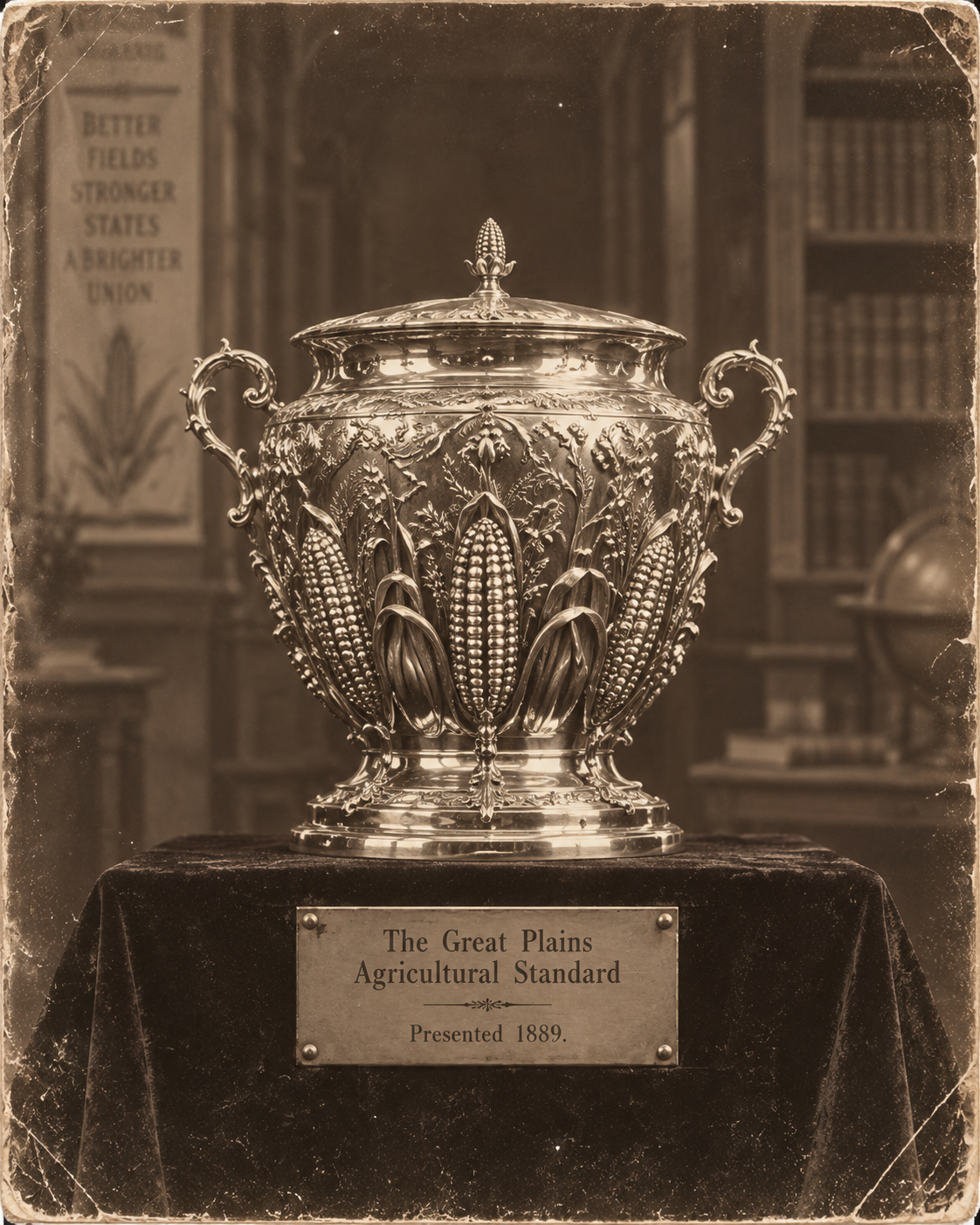
At the Great Plains Agricultural Exhibition of 1889, organizers introduced a new award intended to recognize excellence in corn cultivation:
The Great Plains Agricultural Standard.
The Standard was an elaborate sterling-silver vessel decorated with ears of corn and agricultural motifs. It was intended to symbolize scientific progress, agricultural cooperation, and the shared prosperity of the Great Plains.
It accomplished almost none of those things.
IOWA WINS. NEBRASKA OBJECTS.
The inaugural Standard was awarded to Iowa State College of Agriculture and Mechanic Arts.
Iowa's delegation regarded the result as confirmation that disciplined selection, uniformity, sweetness, and careful cultivation represented the highest expression of Midwestern corn.
Nebraska's delegation reached a different conclusion.
They argued that the judging criteria disproportionately rewarded the qualities Iowa already favored while giving insufficient consideration to vigor, yield, adaptability, drought tolerance, and the realities of farming farther west.
Nebraska did not necessarily dispute that Iowa had won the competition. Nebraska disputed whether Iowa had been allowed to define what winning meant. That distinction would prove consequential.
The question was no longer who had the better corn. The question was who had the right to decide.
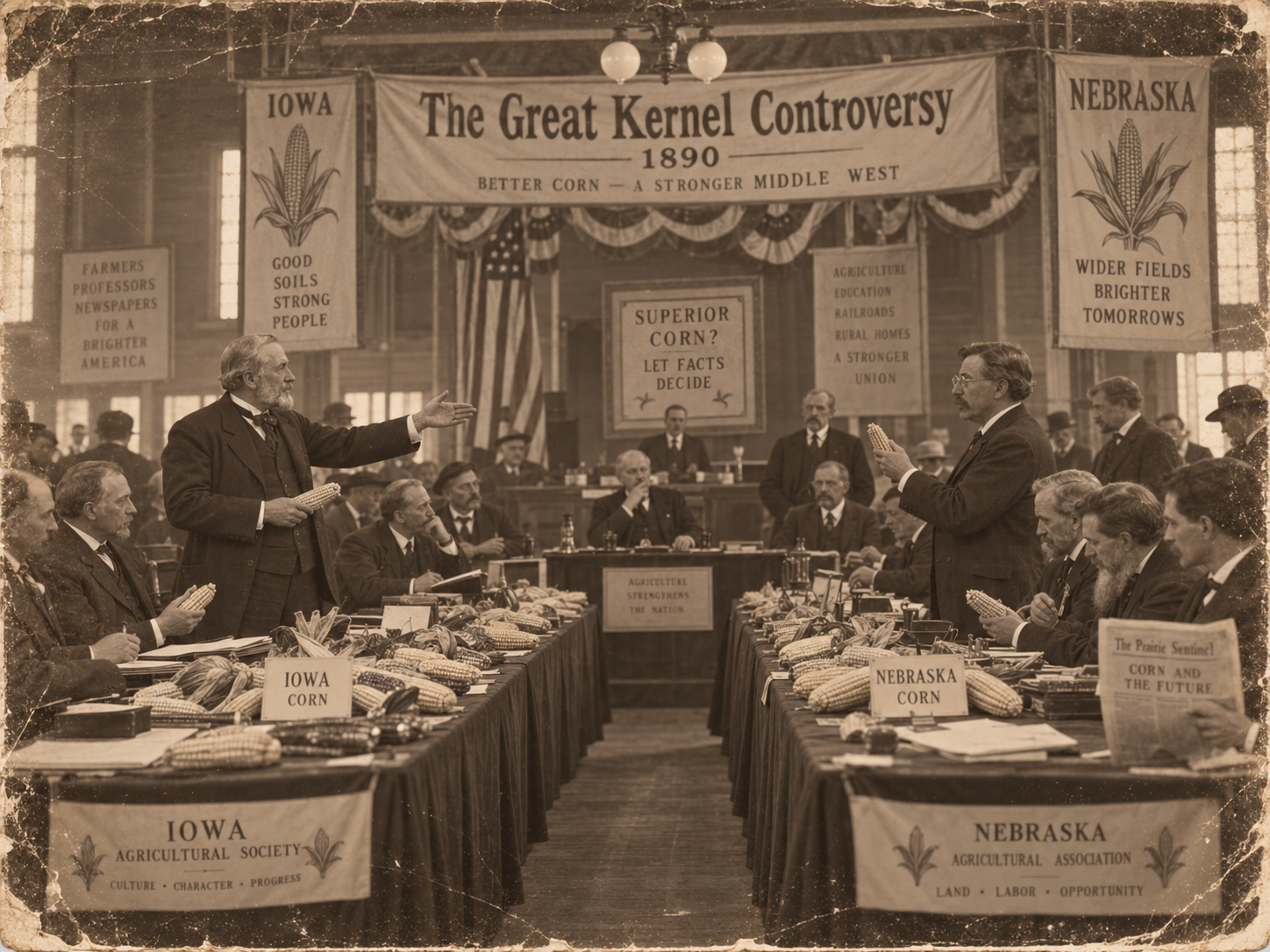
1890 — THE GREAT KERNEL CONTROVERSY
1890 — An agricultural disagreement becomes a regional dispute.
The controversy surrounding the Great Plains Agricultural Standard did not end with the 1889 exhibition.
During the following year, agricultural societies, farmers, university officials, and newspaper editors throughout Iowa and Nebraska increasingly entered the debate. What had begun as a disagreement over judging standards became a broader argument over the very definition of superior corn.
Iowa's position emphasized uniformity, sweetness, careful selection, and refinement. Supporters argued that the best corn was the product of deliberate cultivation and that agricultural science should continuously improve the qualities people valued most.
Nebraska rejected the premise. Nebraska advocates argued that corn should be judged by its ability to thrive under actual Great Plains conditions. Yield, vigor, adaptability, drought tolerance, and usefulness mattered more than producing an attractive and unusually uniform exhibition ear.
Neither position was particularly radical. The problem was that both sides became increasingly convinced that the other was not merely wrong, but was using the wrong definition of corn.
BUDD AND BESSEY
Joseph L. Budd and Charles E. Bessey remained at the intellectual center of the dispute.
Budd's supporters increasingly presented Iowa's approach as evidence that careful scientific selection could improve agriculture throughout the region.
Bessey's allies countered that agricultural science existed to understand nature rather than force it toward an arbitrary exhibition standard.
Their professional disagreement spread well beyond the two men themselves. Farm journals published competing arguments. County agricultural societies adopted resolutions. Farmers submitted ears of corn intended to prove one theory or disprove the other. Exhibition judges were accused of favoritism. Letters circulated between agricultural colleges.
The Great Plains Agricultural Standard had created a question nobody had anticipated:
Was superior corn something that could be objectively measured—or merely something Iowa had defined conveniently enough to win?
THE CORN BELT TAKES SIDES
By the autumn of 1890, the dispute had acquired a life of its own.
The agricultural communities of Iowa and Nebraska began treating the argument as a matter of state pride. What had once been a technical discussion among scholars was repeated at county fairs, agricultural meetings, mercantile associations, and dinner tables throughout the Missouri River Valley.
According to Society tradition, it was during this period that newspapers first began referring to the growing dispute as:
THE CORNFRONTATION
The name endured. The original scholarly question—What constitutes superior corn?—was never satisfactorily resolved. Everything that followed grew from that failure.
“Two states agreed that corn mattered. They agreed on almost nothing else.”
Society account of the Great Kernel Controversy, 1890.
1891–1894 — THE CONTROVERSY SPREADS
From laboratories to county fairs.
After 1890, the debate no longer belonged to Budd, Bessey, or the agricultural colleges.
Farmers began carrying the argument into county fairs and local agricultural societies. Newspapers published competing claims. Merchants displayed prize ears in storefront windows. Judges were challenged over scoring standards, and increasingly elaborate attempts were made to prove that one state had finally settled the matter.
No such settlement occurred. In Iowa, supporters pointed to sweetness, uniformity, appearance, and careful selection as evidence of superior cultivation.
Across the Missouri River, Nebraska farmers continued to argue that corn should be judged by what it could actually accomplish in the field: yield, resilience, adaptability, and usefulness.
By 1893, the debate had become part science, part civic pride, and part entertainment.
THE COUNTY FAIR YEARS
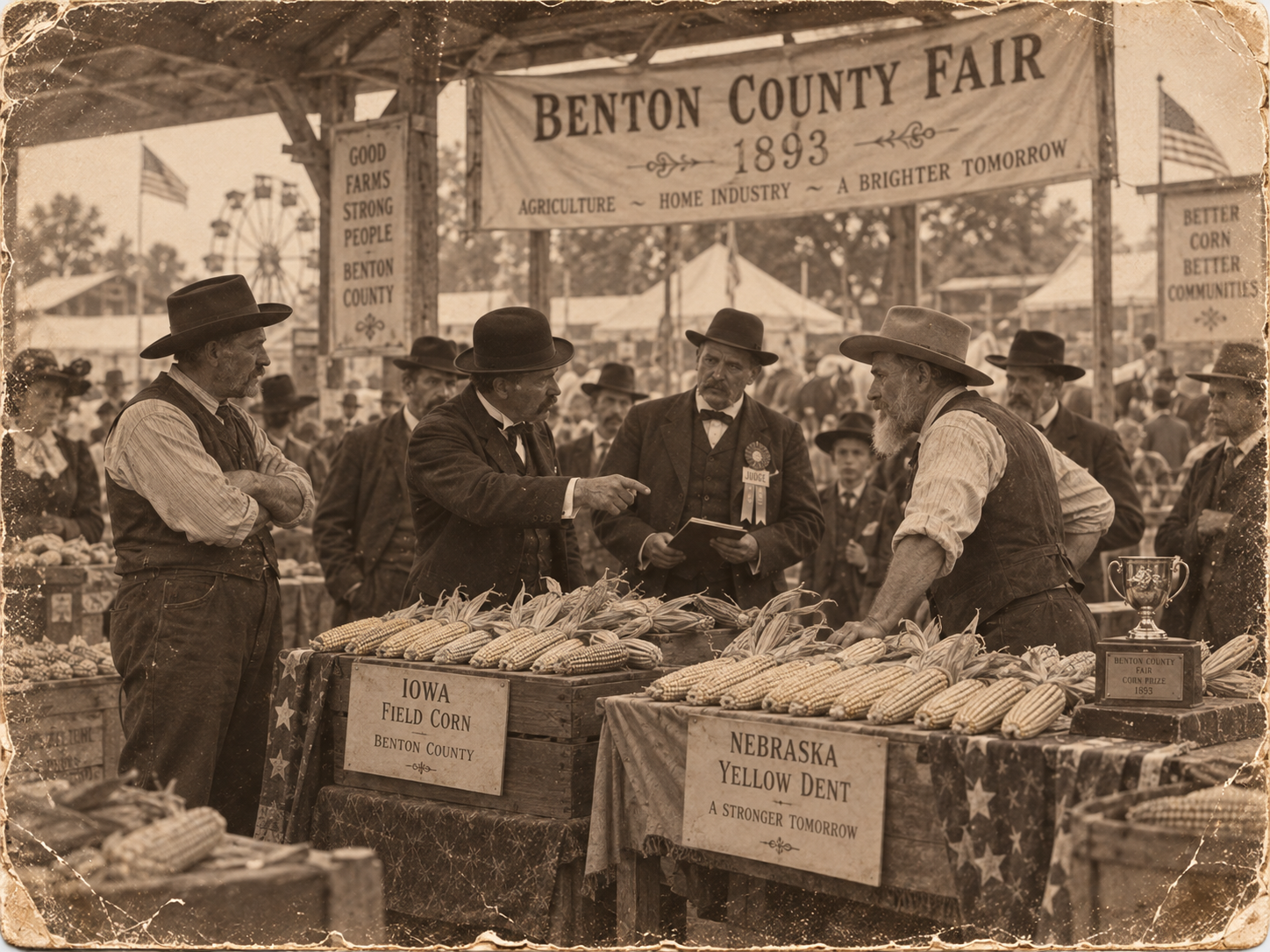
County fairs proved especially fertile ground for the growing rivalry.
Corn exhibits drew spectators who had little interest in plant science but considerable interest in seeing their neighbors proved wrong. Exhibitors began arranging corn by state allegiance. Local newspapers reported arguments between growers with the seriousness normally reserved for elections and railroad expansion.
One surviving Society photograph from the 1893 Benton County Fair shows several men gathered around competing exhibits of white and yellow corn.
Society tradition maintains that the discussion remained entirely civil. The photograph suggests otherwise.
By the mid-1890s, people were no longer simply judging corn. They were choosing sides.
1895–1919 — THE STUDENTS
1895–1919 — A controversy becomes a tradition.
By the mid-1890s, the original scientific dispute had largely escaped the control of the scholars who started it.
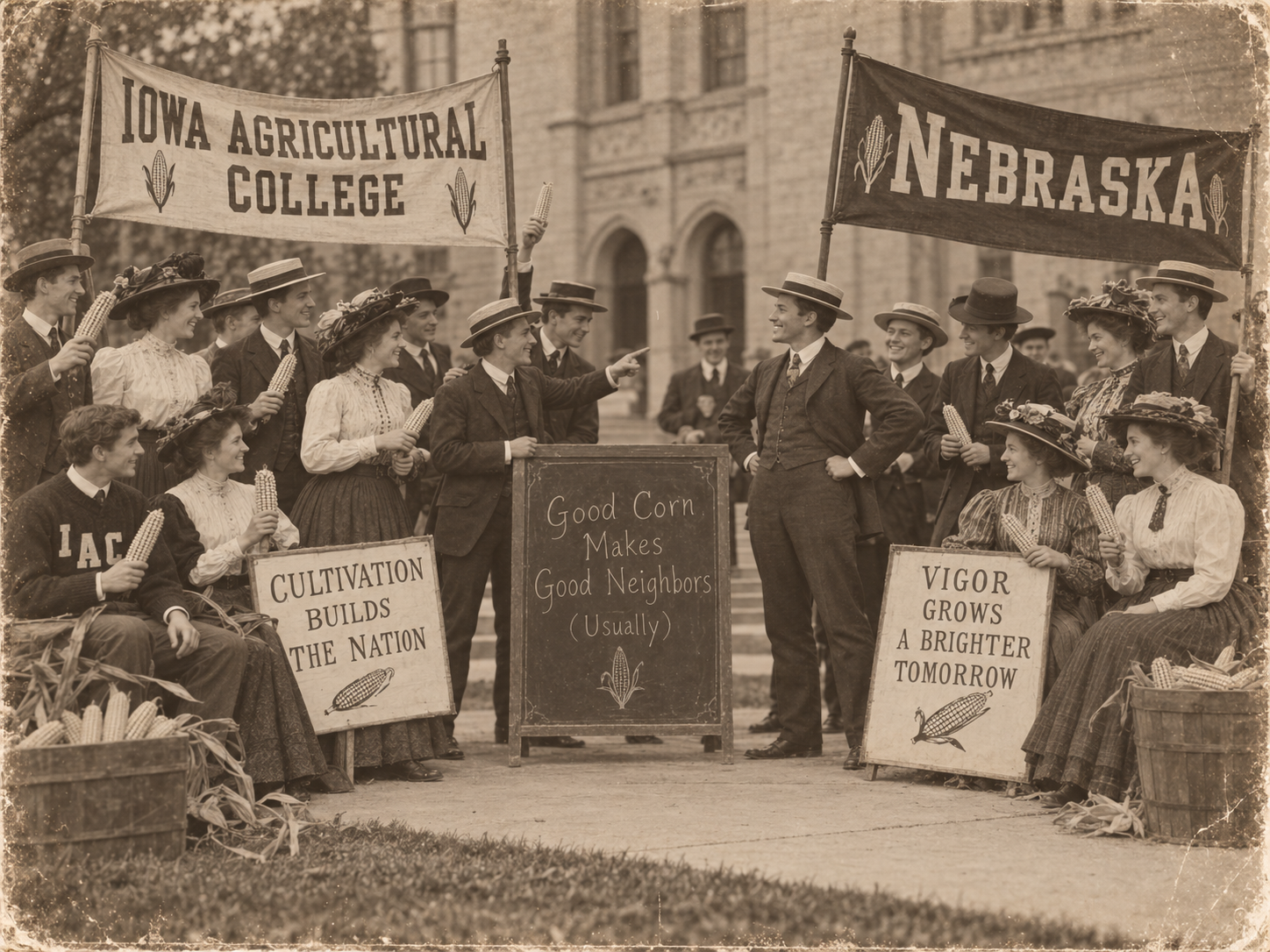
A new generation of students at Iowa and Nebraska inherited the argument without having participated in its beginning. To them, the Cornfrontation was less an agricultural problem to solve and more a rivalry to enjoy.
Student newspapers repeated old arguments about sweetness, yield, uniformity, and resilience—often with considerably less concern for scientific precision.
Banners appeared at campus gatherings. Corn exhibits became opportunities for mockery. Students composed songs, published cartoons, staged informal judging contests, and accused the opposing institution of lowering the standards of Midwestern agriculture.
The precise facts mattered less with each passing year. The story mattered more.
FROM AGRICULTURE TO CAMPUS CULTURE
As intercollegiate athletics expanded in the late nineteenth and early twentieth centuries, the Cornfrontation naturally followed.
Whenever Iowa and Nebraska students found themselves in competition—academic, agricultural, musical, or athletic—the old argument provided a ready-made language for rivalry.
A Nebraska victory was presented as further evidence of the state’s superior agricultural character. An Iowa victory was treated as proof that refinement had once again prevailed over brute yield.
Neither interpretation was particularly defensible. Both became tradition.
By the early twentieth century, students were using the term Cornfrontation for contests that had little or nothing to do with corn.
That was the moment the rivalry became larger than its original subject.
1920–2010 — THE RIVALRY BECOMES A STATE AFFAIR
Ames began the argument. Iowa adopted it. Nebraska refused to let it die.
By the early twentieth century, the Cornfrontation had grown beyond the institutions that created it.
Iowa State College remained the intellectual home of the Iowa position. Its agricultural tradition, experimental work, and connection to the original controversy gave Ames a unique place in the historical record.
But outside the university, people had already begun simplifying the argument. It was no longer Iowa State corn against Nebraska corn. It was Iowa corn against Nebraska corn.
County fairs, newspapers, farm families, and civic organizations carried the rivalry across the state. As the story spread, students and alumni of the University of Iowa increasingly adopted the Iowa position as their own.
No formal transfer of authority appears to have occurred. None was apparently necessary.
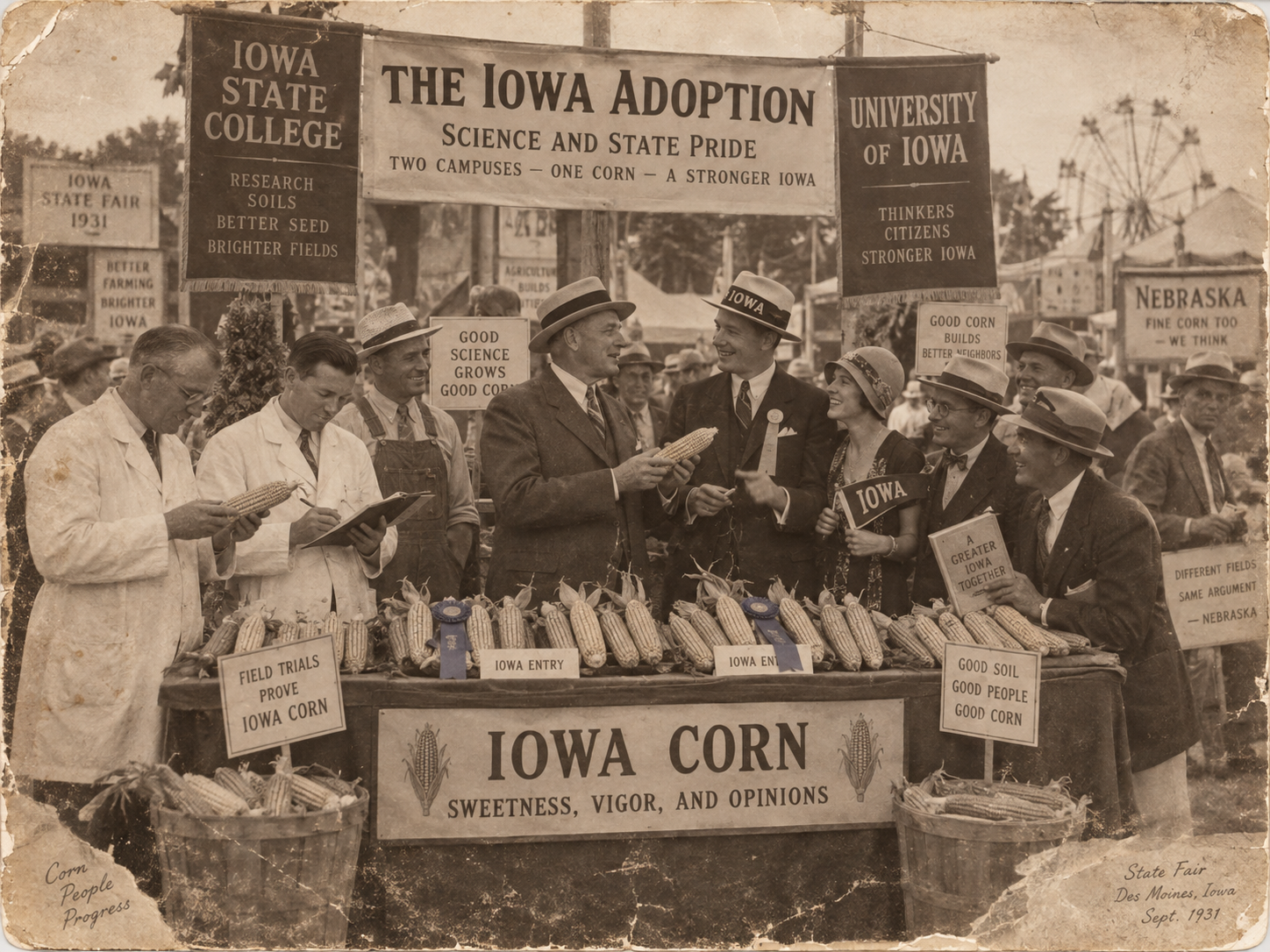
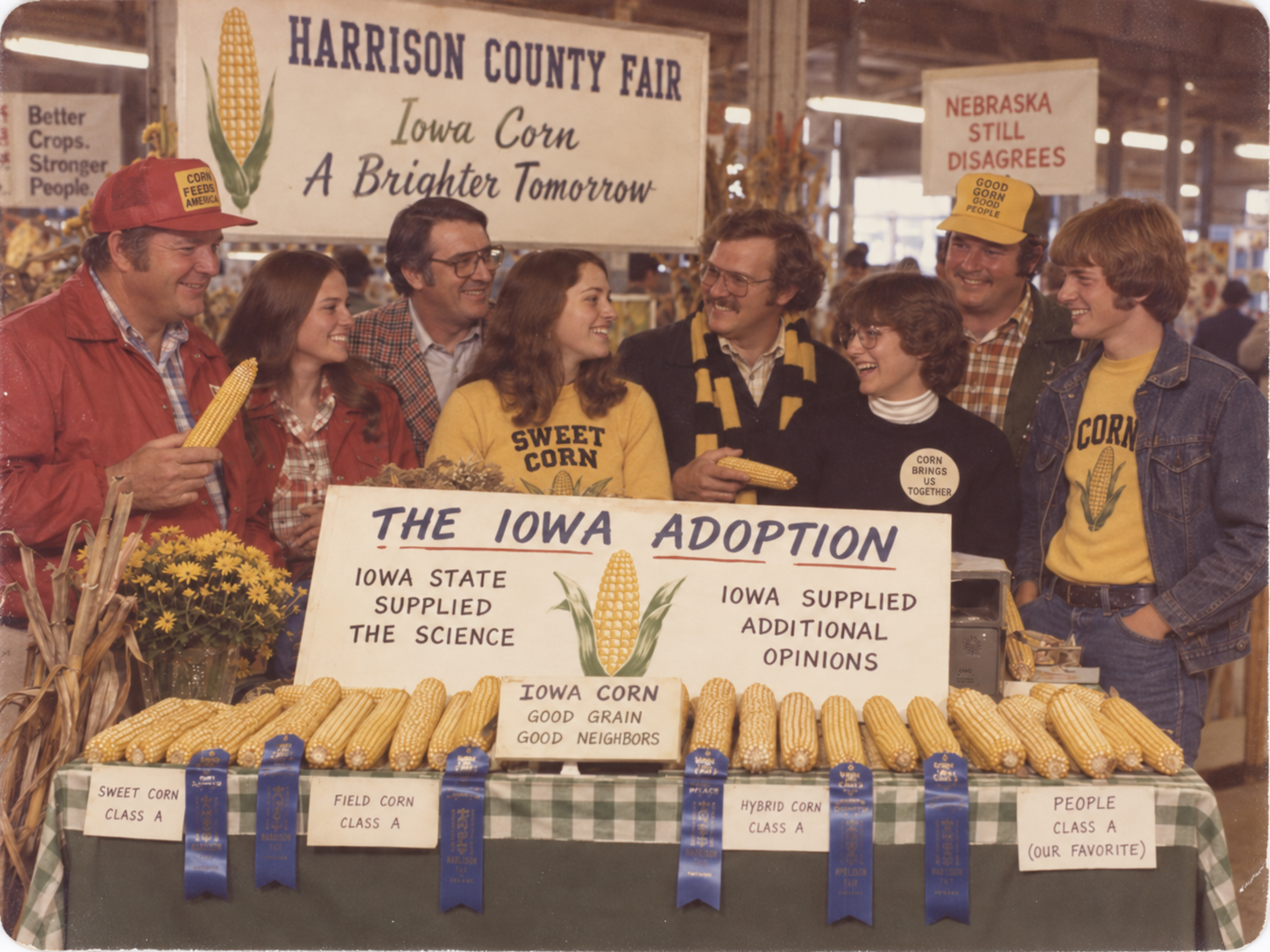
THE IOWA ADOPTION
By the 1920s and 1930s, references to the Cornfrontation had moved well beyond Ames.
University of Iowa students and supporters embraced the fairly obvious proposition that any argument involving the honor of Iowa—and particularly one involving Nebraska—was properly their concern.
Iowa State remained the keeper of the agricultural doctrine. The University of Iowa became one of its loudest defenders. The Society refers to this gradual expansion as The Iowa Adoption.
It was less a transfer of ownership than an enlargement of the constituency.
Iowa State supplied the science. Iowa supplied additional opinions.
DIFFERENT UNIVERSITIES. DIFFERENT CONFERENCES. SAME ARGUMENT.
For most of the twentieth century, Iowa and Nebraska lacked a regular athletic stage on which to settle the matter. That did little to resolve it.
The Cornfrontation instead survived at county fairs, family gatherings, extension meetings, farms, taverns, holiday tables, and throughout the Missouri River Valley.
Iowa State remained tied to the original scientific dispute. The University of Iowa became increasingly associated with the broader state rivalry. Nebraska continued to object to both.
The farther the original controversy receded into history, the less accurately anyone seemed to remember it.
Families embellished stories. County-fair ribbons acquired greater significance with each retelling. Old photographs developed questionable captions. An uncle who once entered six ears of corn in a local exhibition eventually became a renowned authority on Midwestern agriculture.
The Society refers to this as the Oral Tradition. And throughout the Missouri River Valley, families rarely bothered distinguishing between Iowa State and Iowa when announcing that Iowa had better corn.
Nebraska families found this lack of precision especially irritating.
2011–PRESENT
THE RESTORATION
Nebraska joins the Big Ten. The argument finds its game.
For more than a century, the Cornfrontation survived without a reliable way to settle anything.
Iowa State remained the intellectual home of the original Iowa position. The University of Iowa had gradually adopted the broader state claim. Nebraska continued to object to nearly every aspect of both.
The universities competed occasionally. Families argued constantly. County fairs, farm gatherings, holidays, agricultural meetings, and conversations throughout the Missouri River Valley kept the controversy alive.
Then, in 2011, Nebraska joined the Big Ten. Suddenly, Iowa and Nebraska were no longer merely neighboring states with a long history of agricultural disagreement. They were regular conference opponents.
The Cornfrontation had found its game.
THE RESTORATION, NOT THE BEGINNING
The Society rejects the suggestion that the modern Iowa–Nebraska rivalry began in 2011.
That interpretation ignores more than a century of disputed corn judging, questionable agricultural doctrine, family arguments, county-fair controversy, and regional stubbornness. 2011 did something far more important.
It restored the argument to an annual public stage.
For generations, families living on opposite sides of the Missouri River had already been conducting their own Cornfrontations. Nebraska's entry into the Big Ten simply gave the universities a schedule.
The rivalry that followed therefore felt strangely familiar. The uniforms were new. The argument was not.
THE GRAND CORNFRONTATION
Every contest matters. One matters more.
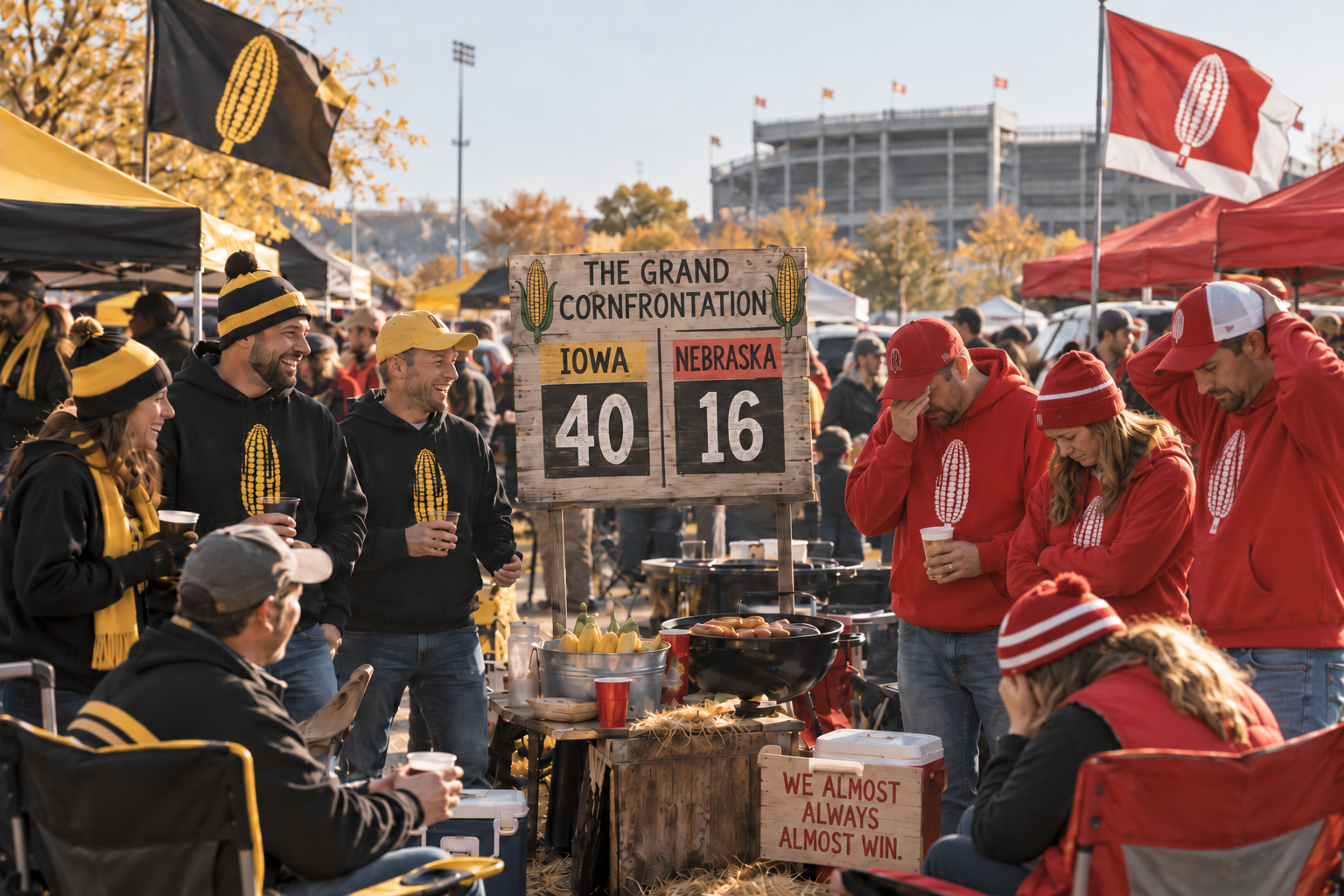
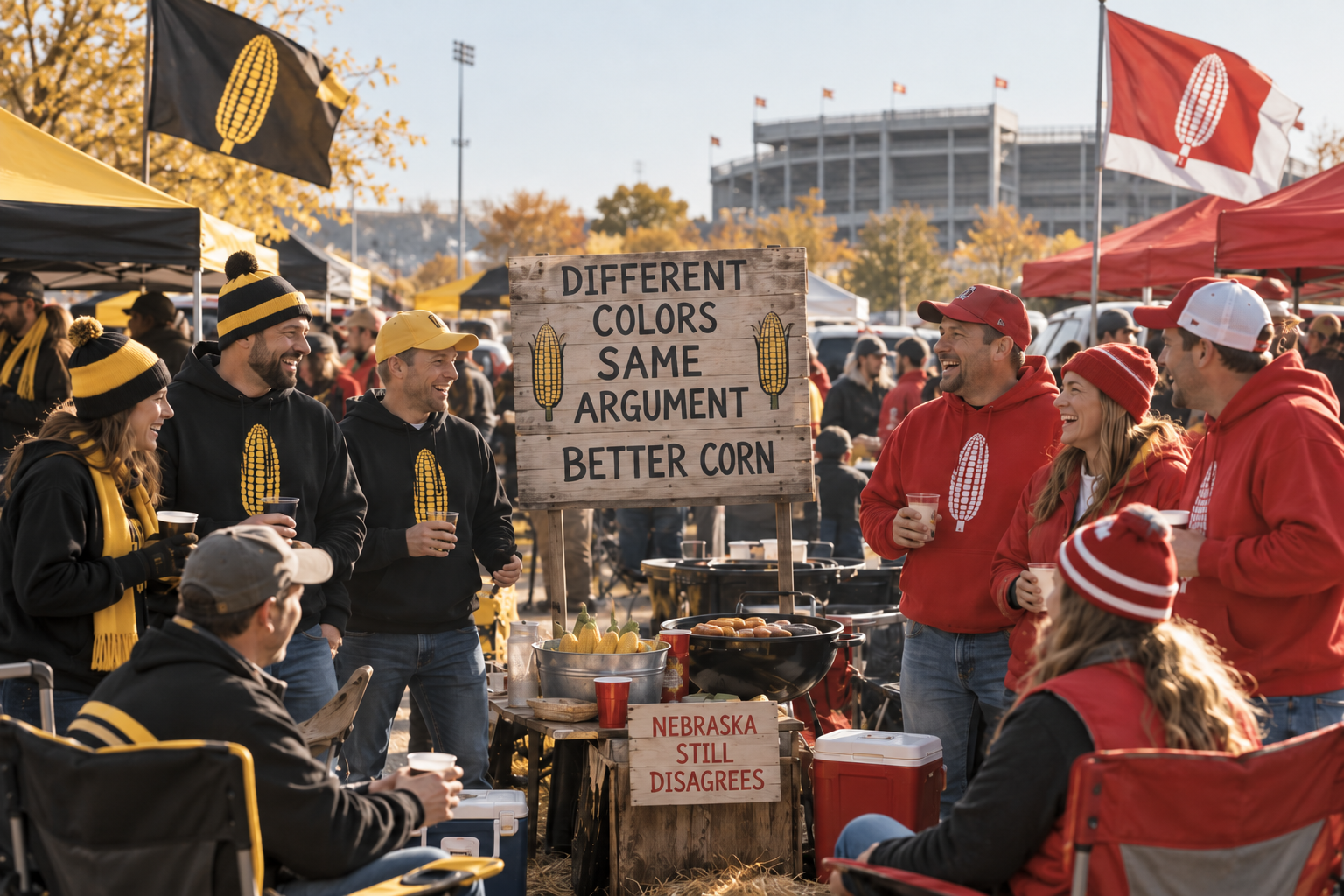
In the modern era, any athletic contest between Iowa and Nebraska may properly be considered a Cornfrontation. Basketball, wrestling, volleyball, baseball, track, golf, and any other competition can provide temporary evidence in the continuing dispute.
But one contest occupies a special place in the Society’s historical record. The annual Iowa–Nebraska football game is recognized as The Grand Cornfrontation.
Once each year, more than a century of agricultural disagreement, state pride, family argument, questionable historical interpretation, and regional stubbornness is temporarily reduced to a scoreboard.
The winner receives the privilege of interpreting the Cornfrontation historical record until the next meeting. The losing side is expected to endure reasonable criticism concerning its football team, judgment, and corn. This arrangement does not actually settle the dispute. That is considered one of its principal advantages.
THE ANNUAL VERDICT
The Society recognizes a simple modern principle: Winning does not prove that your corn is better. It merely permits you to behave as though it does.
Following the Grand Cornfrontation, the victorious side receives temporary control of the modern Cornfrontation narrative. When Iowa prevails, the Society adopts black and gold, and Nebraska is reminded that it has bad corn.
When Nebraska prevails, the Society shifts to red and white, and Iowa receives the same carefully considered agricultural assessment.
The judgment remains in effect until the next Grand Cornfrontation. No appeals are recognized.
MORE THAN FOOTBALL
The Cornfrontation ultimately belongs to more than either university. Its most important participants have always been the families who live between them.
They are the people who grew up in one state and moved to the other. The grandparents whose children chose different schools. The cousins who meet at Thanksgiving wearing opposing colors. The farmers who cross the Missouri River, the families who attend the same county fairs, and the neighbors who spend most of the year getting along perfectly well until someone makes an unnecessary comment about corn.
That is where the Cornfrontation survives. Not because either side expects the argument to be resolved. Because nobody really wants it to be.
A DIFFERENT KIND OF RIVALRY
The Cornfrontation is built on the belief that disagreement can still be enjoyable. The opposing side should be mocked. Its agricultural judgment should occasionally be questioned. Its football failures should be documented carefully and preserved for future generations. But when the argument is over, everyone should still be welcome at the same table.
That principle connects the modern rivalry to the story the Society claims began more than a century ago. The details have changed. The participants have changed. Even the institutions representing the Iowa side have changed. The essential tradition has not.
Two neighboring states remain convinced that the other one does not properly understand corn. And once a year, they get a football game to discuss it.
The game ends. The argument does not.
THE MODERN DIVISION OF RESPONSIBILITY
By the time Nebraska joined the Big Ten, the Iowa side of the Cornfrontation had become more complicated than the original dispute between Ames and Lincoln.
The Society therefore recognizes three distinct modern roles.
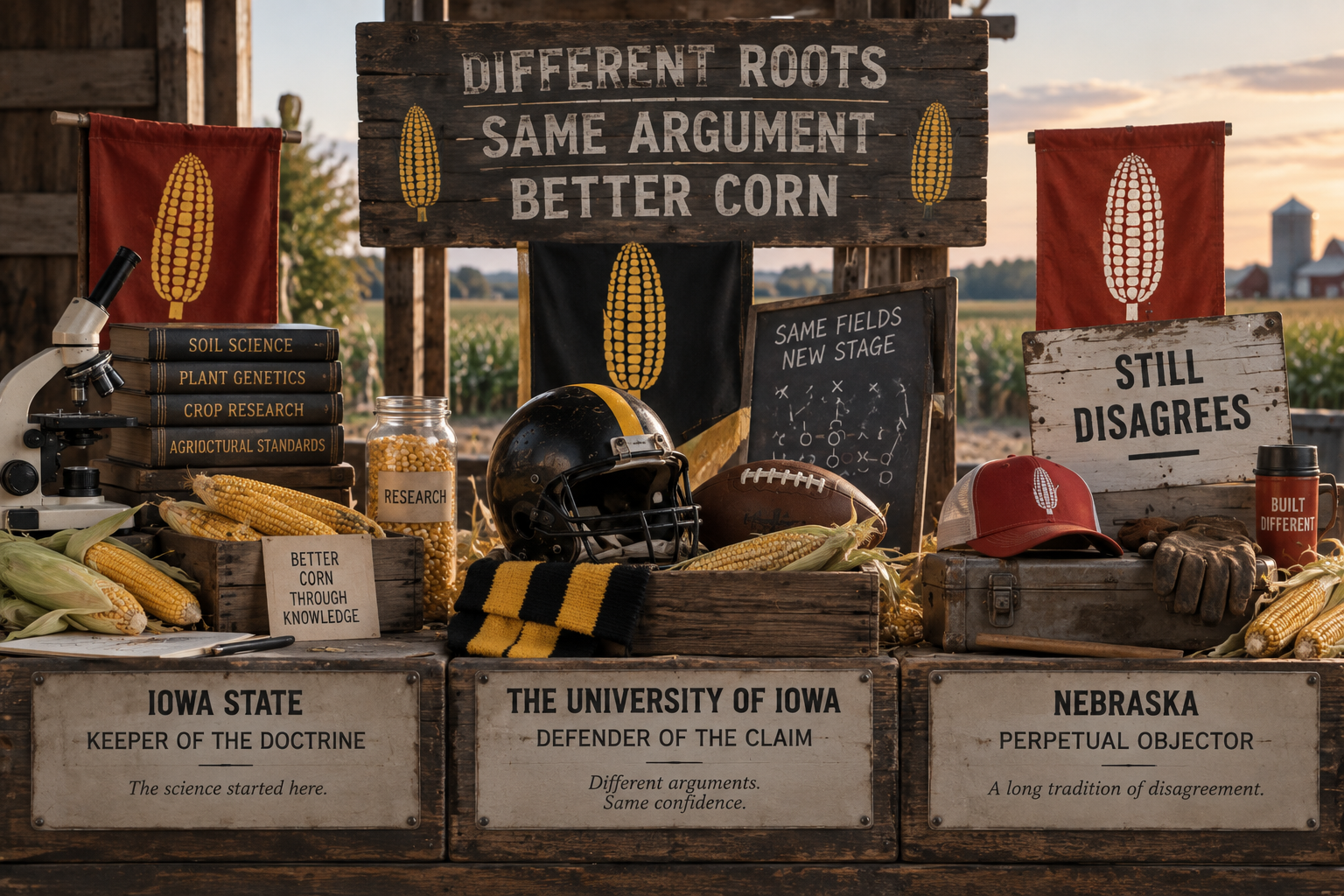
IOWA STATE — KEEPER OF THE DOCTRINE
Iowa State remains the historical custodian of the original Iowa position.
The agricultural scholars at Ames helped create the scientific arguments, judging standards, cultivation practices, and institutional confidence that produced the first Cornfrontation.
Without Iowa State, there is no Iowa doctrine. Without the Iowa doctrine, Nebraska would have had considerably less to complain about.
THE UNIVERSITY OF IOWA — DEFENDER OF THE CLAIM
The University of Iowa did not create the agricultural argument. It simply became very enthusiastic about defending Iowa’s honor.
As the Cornfrontation evolved from an academic dispute into a matter of state identity, Iowa supporters increasingly adopted the obvious position that Iowa corn must be superior because it was grown in Iowa.
The supporting evidence varied considerably. The confidence did not.
When Nebraska entered the Big Ten, the University of Iowa became the principal modern athletic representative of that claim.
Iowa State supplied the science. Iowa supplied additional opinions.
NEBRASKA — PERPETUAL OBJECTOR
Nebraska’s role has changed the least.
Since the earliest disputes over the Great Plains Agricultural Standard, Nebraska has maintained that Iowa’s definition of superior corn is overly concerned with appearance, uniformity, sweetness, and standards suspiciously favorable to Iowa.
Nebraska continues to advocate vigor, usefulness, adaptability, yield, and the obvious agricultural wisdom of Nebraska. The Society recognizes this position as historically consistent. Whether it is correct remains under review.